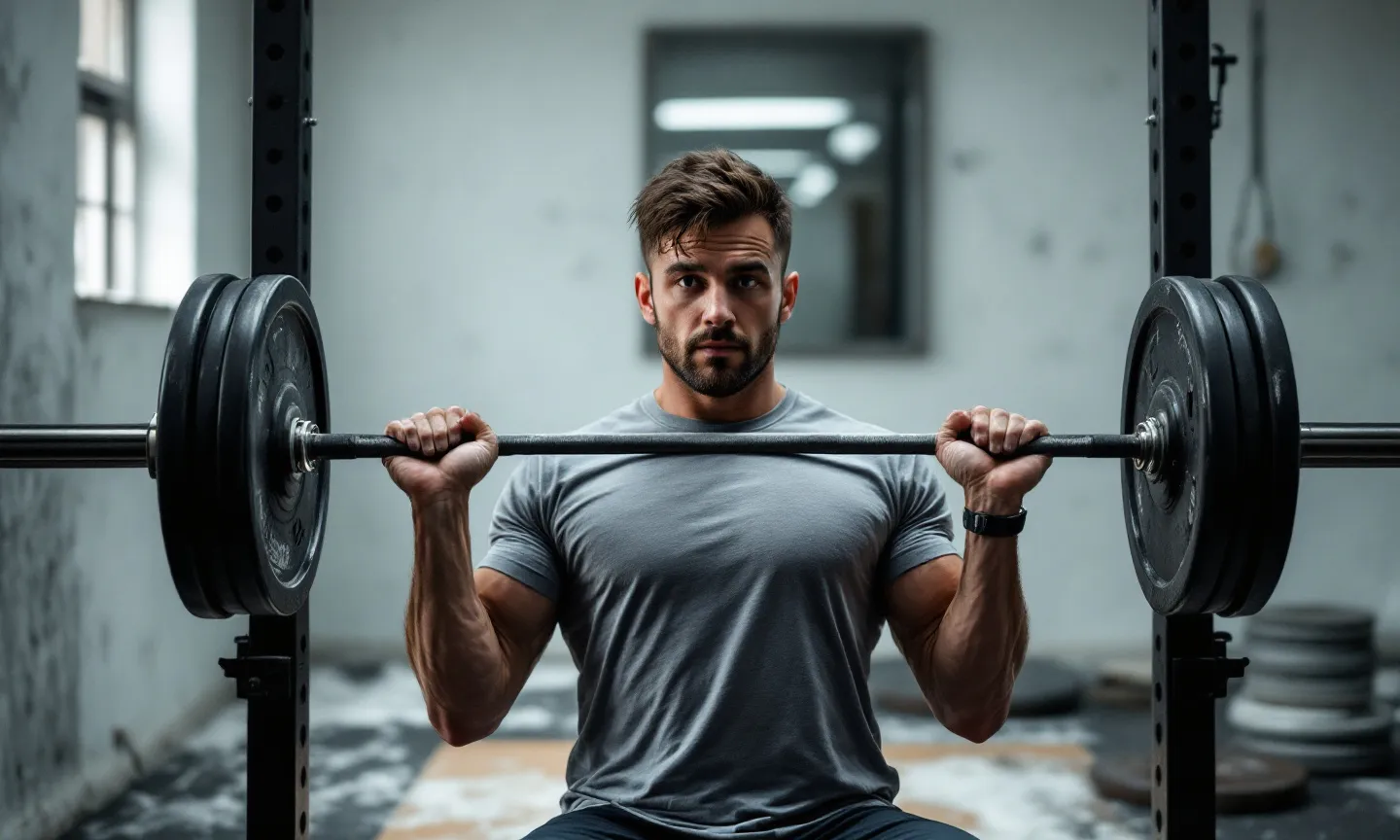
AI Gym Photo Prompts for Men That Look Shot, Not Rendered
Generated gym photos give themselves away on three details: a gym too clean, muscle too uniform, sweat drawn wrong. The prompt structure that fixes all three.
Gym content is one of the highest-volume categories in AI photo generation right now, and it is also one of the worst-executed. Scroll any fitness hashtag and you can pick out the generated images in about a second: impossibly even muscle definition, a gym with no clutter in it, sweat that sits on the skin like glitter, and a physique that does not match the face above it.
That last one is the real killer, and it is worth naming plainly before anything else. If you generate a body that is not remotely yours and post it as a progress photo, you are not making content — you are making a claim about yourself that a single real-life encounter disproves. The prompts below are written for the honest version of this: shooting the physique you actually have in lighting and framing that a real photographer would use, instead of paying for a studio session.
That constraint is not a limitation. It is the reason these come out looking like photographs.
Why Most Generated Gym Photos Fail
Three failure modes account for nearly all of it.
The gym is too clean. Real gyms are cluttered. There are plates left on the floor, a water bottle on the bench, tape on a barbell, scuffs on the rubber flooring, a fire exit sign in the background. Generated gyms come out looking like a rendering from an equipment catalog, because "modern gym" without further detail resolves to the model's average of marketing photography.
The muscle is uniform. Models trained on fitness marketing default to symmetrical, evenly-lit, evenly-developed musculature. Real bodies are asymmetric, have uneven development between sides, and show muscle definition that changes drastically with the angle of the light. Uniformity reads as CGI faster than almost anything else.
The sweat is wrong. This is the specific tell most people cannot articulate. Generated sweat tends to appear as discrete droplets scattered evenly across skin. Real sweat under gym lighting is mostly a broad specular sheen — a shine along the shoulders, the top of the traps, the forearms — with actual droplets only at the hairline and temples. Ask for "sheen," not "droplets," and the image gets ten percent more believable for free.
The Structural Fix: Describe the Room Before the Body
The instinct is to spend the whole prompt on the physique. Do the opposite. Spend the first half on the room, because the environment is what sells the photo as a photograph, and the environment is what the model most reliably renders wrong.
A gym description that works has three layers:
Equipment in the near field. "A loaded barbell on the floor with two 45-pound plates, knurling visible, a strip of athletic tape on the sleeve."
Clutter in the mid field. "A stray 25-pound plate leaning against the rack, a chalk-dusted bench, a water bottle and a phone on the floor."
Architecture in the far field. "Exposed black ceiling with visible ductwork, a mirrored wall thirty feet back reflecting the rack, high industrial windows on the left."
That third layer is where depth comes from. A background that is just "blurry gym" has no distance in it, and images with no distance read as flat and synthetic.
Lighting: Hard, Not Flattering
This is counterintuitive if you are used to portrait advice. Soft, even light is flattering to faces and terrible for physique photography, because muscle definition is entirely a function of shadow. Flat light erases the thing you are trying to show, and the model compensates by drawing in definition that is not anatomically grounded — which is exactly the fake look.
Hard light does two jobs at once: it carves real definition, and it exaggerates skin texture instead of smoothing it. Both push the image toward photographic.
Language that works:
- "Single hard overhead source directly above, creating deep shadow beneath the pec line, the lat insertions, and the clavicle."
- "Strong side light from a high industrial window camera-left, the camera-right side of the body falling two to three stops into shadow."
- "Cool practical light from overhead LED strips, mixed with warm tungsten from the far wall, creating a slight color split across the torso."
That last one — mixed color temperature — is a quiet realism multiplier. Real rooms almost never have one light temperature. Generated rooms usually do.
Motion Beats Pose
A flexed, front-facing, arms-out pose is the most common gym prompt and the one that most reliably produces something that looks staged. The reason is that the model has millions of examples of exactly that pose from bodybuilding marketing, and it regresses to the marketing look.
Mid-movement framing pulls it away from that average:
- "Mid-set on a barbell row, torso hinged forward, bar just below the knees, back engaged, gaze down."
- "Racking a dumbbell, one arm extended toward the rack, weight shifted onto the front foot, looking away from the camera."
- "Seated on a bench between sets, forearms on knees, head down, breathing hard, towel over one shoulder."
The last one in particular reads as documentary rather than promotional, and documentary is the register that performs best in 2026 — it is the same shift toward candid, unposed framing that drives the "steal this prompt" cinematic trend.
Camera Language for Gym Shots
Gyms are low-light, high-contrast rooms, and real gym photography looks like it. Naming the constraints of shooting in one gets you the right look:
"Shot handheld on a 35mm lens at f/1.8, ISO 1600, slight motion blur in the trailing hand, visible sensor grain in the shadows, focus on the near shoulder with the far arm falling slightly soft."
Three things there are doing specific work. ISO 1600 implies noise, and noise implies a real sensor in a dim room. Slight motion blur implies a shutter that was open while something moved — an artifact no render produces by accident. Selective focus implies a physical lens with a focal plane rather than an all-in-focus composite.
Skin, Sweat, and the Honest Physique Clause
The skin vocabulary is the same as everywhere else: visible pores, uneven tone, natural asymmetry, no retouching. Gym photos add two specifics.
Sheen over droplets. "Broad specular sheen across the shoulders, traps, and forearms; a few actual droplets only at the hairline and temple; damp patch at the center of the shirt collar."
Flush. Exercise reddens skin, unevenly. "Slight flush across the chest, neck, and cheeks; visible vascularity in the forearms only, not across the whole body." That last clause matters, because the default output veins everything.
And then the honest clause, which is the one that keeps this useful rather than delusional:
"Keep the exact body proportions and muscle development from the reference photo. Do not enlarge, slim, or add definition. Same shoulder width, same waist, same arm size."
Without that instruction, every model on the market will quietly inflate you, because its training data for "gym photo" is overwhelmingly competition-level physiques. You have to explicitly opt out.
Three Prompts to Start From
Between sets, documentary. "Photorealistic candid gym photograph of the person in the reference image. Seated on a flat bench between sets, forearms on knees, head slightly down, towel over one shoulder, breathing hard. Wearing a heather-gray cotton tee, damp at the collar and center chest. Foreground: a loaded barbell on the rubber floor with visible knurling and athletic tape on the sleeve. Mid ground: a stray 25-pound plate against the rack, a water bottle and phone on the floor. Background: exposed black ceiling with ductwork, a mirrored wall thirty feet back, high industrial windows camera-left. Single hard overhead source plus cool LED strips mixed with warm tungsten from the far wall. Shot handheld on a 35mm lens at f/1.8, ISO 1600, grain visible in the shadows, focus on the near shoulder. Broad specular sheen on shoulders and forearms, droplets only at the temple, slight flush across the neck and cheeks, visible pore texture, no retouching. Keep the exact body proportions and muscle development from the reference photo. Not CGI, no plastic skin, no added definition."
Mid-lift, low angle. Same environment block, but: "Mid-set on a barbell row, torso hinged forward, bar just below the knees, gaze down at the floor. Low camera angle at bar height, 35mm, slight motion blur in the bar. Hard side light from the industrial window camera-left, camera-right side of the body falling three stops into shadow."
Locker-room aftermath. "Standing at a locker, one hand on the open door, unwrapping a wrist wrap, looking off-camera. Overhead fluorescent strips only, hard shadows under the brow and jaw, cool green-tinged color cast. 50mm at f/2.0, ISO 3200." The green fluorescent cast is unglamorous and therefore extremely convincing.
Where This Sits Next to the Rest of Your Feed
Gym photos are usually one pillar of a wider personal-brand feed, not the whole thing, and the failure mode is having one set that looks like a different person than the other sets. Lock the same face and build descriptor across all of them — that discipline is covered in getting consistent AI photos across generations — and vary the environment rather than the person. The broader strategy for building a feed that holds together is in AI photos for an Instagram personal brand.
Where PROMPTMVSTR Fits In
The three-layer environment structure, the hard-light discipline, and the honest-physique clause are all standard construction in the prompt archive — every entry pairs the prompt with the output it produced, so you can see whether the room actually rendered with depth before you spend a generation on it. If you want the gym set and the rest of your feed to match, the Virtual Photoshoot reuses a single reference across a full batch, and luxury lifestyle prompts for men covers the adjacent pillars most people pair this with.